What are sun dogs?
Introduction
Sun dogs are also called parhelia (singular: parhelion, from "para" – beside; helios – the sun. From Greek). Nobody can agree where the name "sun dog" came from, though.
They're an atmospheric phenomenon, where a bright spot appears either side of the sun.
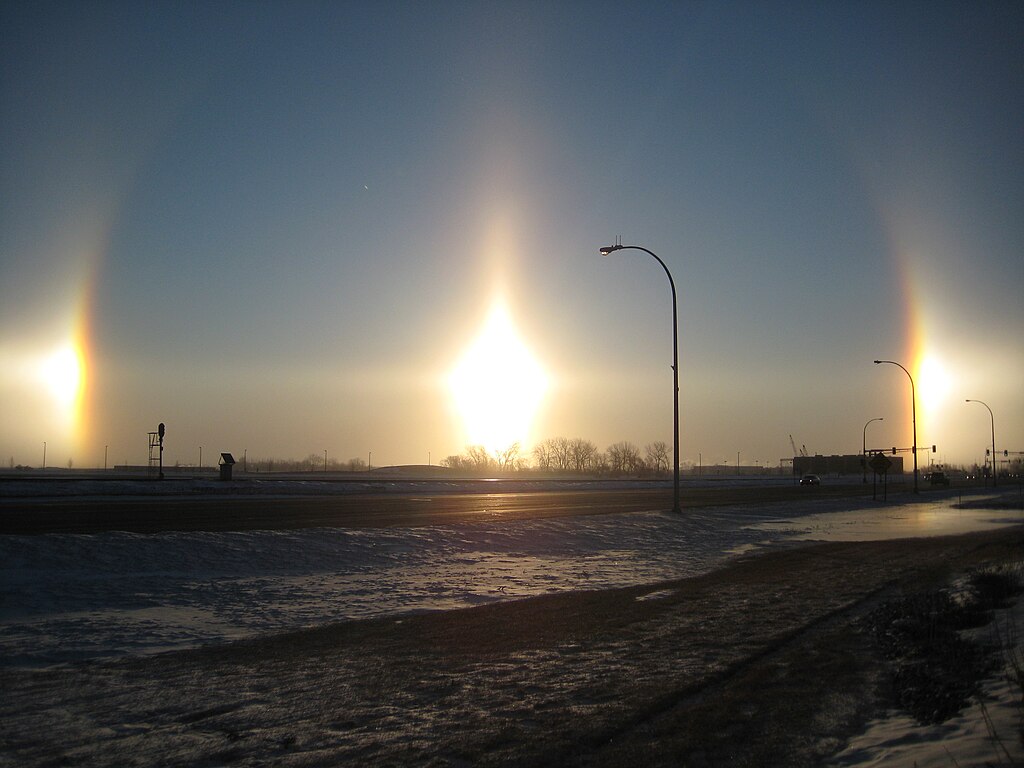
Where I'm from, the existence of sun dogs is common knowledge. And when I say "where I'm from", I mean the small village on the Welsh borders, population roughly 1000. The village is only a mile or so from Mortimer's Cross, the site of one of the battles of the English Civil War.
The story goes that before the battle, there appeared in the sky "three suns". The Yorkist commander convinced his troops that it represented the house of York and thus god was on their side. Spurred on with confidence, the Yorkists won what was an important battle.
The Yorkist commander later became King Edward IV of England, and he took the sun as part of his crest, so apparently this made a big impression on him.
How they happen
The quick version: They're caused by sunlight refracting.
The long version: They're caused by sunlight refractingReflection is when a ray of light hits a surface and bounces back off. The bounce is at the same angle as it arrived at.
Refraction is when the light enters the thing it hit. As it enters, it changes direction. through ice crystals floating in the air. Nobody has quite worked out what shape the ice crystals are; the most common theory is hexagons, and we're going to work with that assumption.
Light from the sun hits the ice crystals. It can hit any of the faces of the hexagon. The angle it hits the face at depends on the rotation of the hexagon.
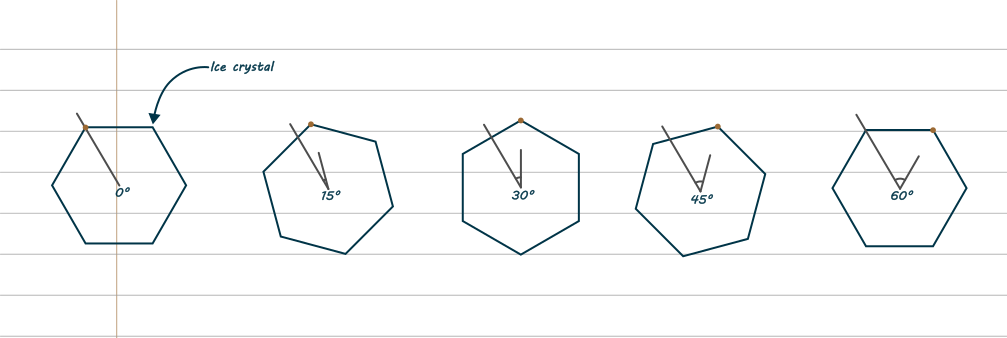
As we're assuming the ice crystals are regularA regular shape is one where each side is the same length and each angle is the same angle hexagons, the faces are 60° apart from each other. Every time we rotate the crystal by 60°, it ends up in the same place again. I've put a dot on one corner just so you can see how it's turning.
The sun is a long way away, so we can assume that the rays are parallelThis is an assumption that comes up a lot in science – when you get far enough away from something, you can assume things appear in straight lines instead of curves..
Lets see what happens if light hits those different hexagons. The light is coming from the top of the screen and hitting the ice crystal hexagons. As it hits the crystal it bends once when it goes from air to ice, and then bends again when it goes from the ice back into air.
In the picture, the angles where the light enters the crystal are all quoted relative to the normal, which is an imaginary line at 90° to the face of the shape.
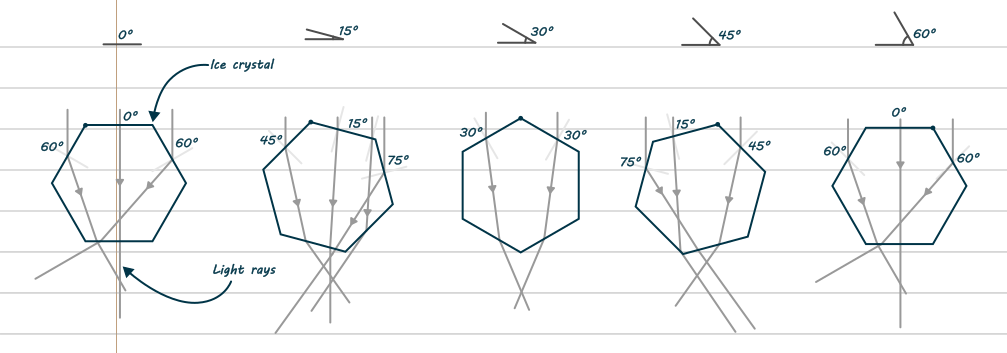
So, looking at the picture, the light can hit the crystal at any angle from 0 to 60°. Now look at the rays hitting the right sides of the crystals: it seems that almost no matter what the incident angle (the angle the light enters the crystal), its going in roughly the same direction when it comes out the other side. The difference between the angle it went in at and the angle it came out at is called the deviation angle.
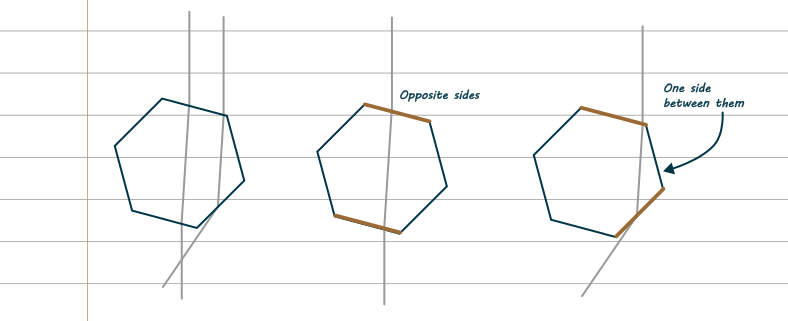
Notice how, most of the time, the light is going through two faces that have one face between them. There's a special case where sometimes the light goes through two faces that are opposite. In those cases, the light doesn't actually change direction. Instead, it just comes straight back out in the same direction it went in. The light rays in this case don't contribute to sun dogs, so we'll be ignoring them. In fact, we're going to ignore incident anglesThe angle between the light entering and the face of the crystal up to about 15°, because all of those have probably just gone straight through.
What if I overlay all those different crystals so we can compare it a bit better. Look – the light all ends up pointing in about the same direction!
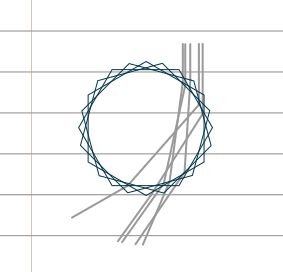
I've drawn lots of lines to show how light refracts as it goes through an ice crystal. Those lines aren't at made up angles; they're based on an equation that I'll explain in another article. What the equation does show, though, that is that the incident angleThe angle between the light entering and the face of the crystal and the deviation angleThe difference between the incident angle and the angle the light came out at are related.
That's a whole lot of sin. What you can say from this equation, though, is that the deviation angle (θd)The difference between the incident angle and the angle the light came out at only depends on two things: the incident angle (θi)The angle between the light entering and the face of the crystal and the refractive indexThe refractive index is a number that tells you how slowly light travels through this material, relative to the speed it travels through a vacuum of the ice, n. How can you say that? Because everything in the equation is a constantA number that isn't changing based on something we're looking at. is still no matter what colour light, what material or day of the week it is apart from θi and n.
actually varies depending on the colour of light you've got and the material its travelling through. Obviously the material here is just ice, so that's not changing. The only thing we care about is the colour of light then. Hold that thought – we'll come back to it later. For now, we're just going to assume , which is the number for red light.
We can put all the numbers we've got into the equation above, and we can use it to see what incident angles we get. Before, I just showed ice crystals that rotated by 15°. I can write a computer program that calculates the deviation angle for incident angles in steps of 0.1° and then plots them all on a graph together - much faster than doing it by hand!
I wrote this in Octave, which is like MATLAB but open source and free. Here's the code.
incident = 15:0.1:75;
incidentrad = deg2rad(incident);
deflectionrad = incidentrad + (asin(n*sin((pi()/3) - asin(sin(incidentrad)/n)))) - (pi()/3);
deflection = rad2deg(deflectionrad);
figure
plot(incident, deflection);
xlabel("Incident angle (degrees)")
ylabel("Deflection angle (degrees)")
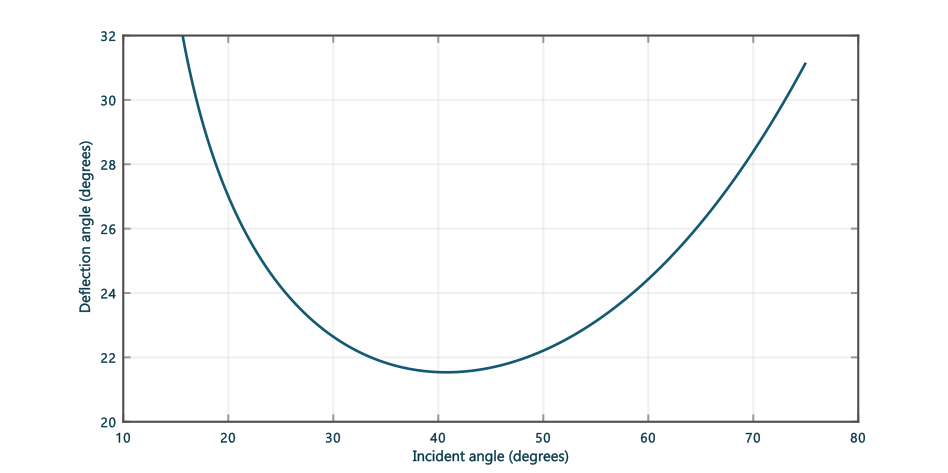
The x axisThe one along the bottom. This is the independent axis. When you're plotting a graph, you put the thing you're changing along the bottom is the angle the hexagon is at.
The y axisThe one up the side. This is the dependent axis. You use it to plot what you're measuring as a result of the thing you are changing. is the deflection angle.
As you change the angle of the ice crystal, the deflection angle changes. The least it can deflect by is roughly 22°. The curve is quite steep around the edges. This tells you that only a small change in the angle of the ice crystal means quite a big change in the deflection angle. In the middle of the curve, around 40° on the x axisThe one along the bottom, the line is much flatter. This means that even quite a large change in ice crystal angle only causes a small change in the deflection angle.
The interesting part here is that the lowest point of the curve is at around 22°. What that tells us is that no matter what direction the ice crystal is facing, the light is deflected by at least 22°. Remember all the way back up the top I showed a picture of some sun dogs, and they were two bright spots on a bigger circle? That bigger circle is called a 22° halo.
How does light bending result in sun dogs?
What we see is not because of 'vision' coming out of our eyes or something. It's because of light bouncing off things and ending up in our eyes. When you see something in a certain direction, it means light from that object is coming into your eye from that direction. The thing might not actually be there – it's just where the light from it is coming from.
The more light that ends up in our eyes from a given direction, the brighter that direction looks.
While the crystals can be at lots of different angles, the maths showed that there are a lot of different incident anglesThe angle between the light entering and the face of the crystal that result in roughly the same deviation angleThe difference between the incident angle and the angle the light came out at. That means if you look in that direction, there is more light coming from that way, and so you perceive it as brighter.
Assume that the angles of the ice crystals are completely random. That means there's going to be roughly the same amount of them with incident angles of 10°, 20, 30, 25.5, 31.632°.
If we can assume that there's the same amount of them at all the different angles, we don't need to look at every single crystal in the sky to work out which deflection angles are most common. We can just take a sample. After all, if you have ten of each thing, you'll get the same overall shape as if you have one of each thing, right?
So, we're going to just take a one for each angle. One at 20, 20.1, 20.2, 20.3° and so on, all the way to 60°. And then we work out what deflection angle we get for each of them.
Once we've worked out all the different deflection angles, we can group the answers together. If the answer is between 20 and 21, it goes in the first box. If it's between 21 and 22, it goes in the next box. And so on.
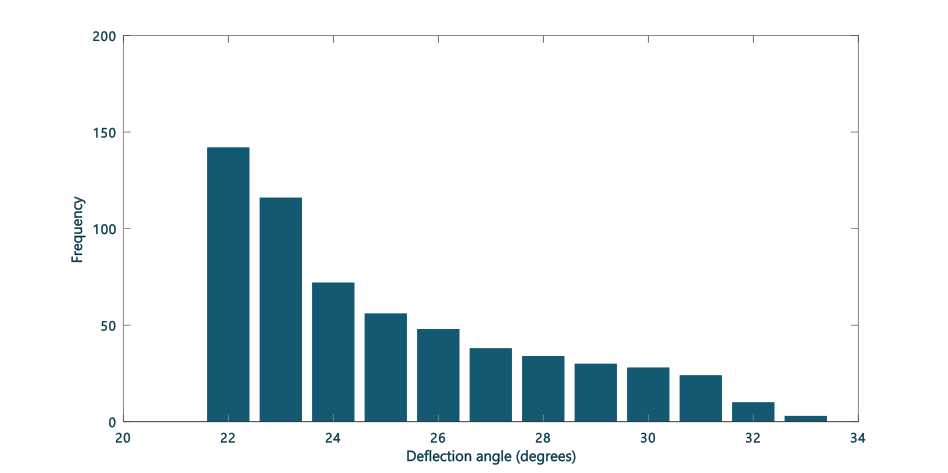
The last step is to then plot how many results you put in each box (called a 'bin'). The height of the bar tells you how many are in the box for that number. This type of graph is called a histogram.
You can see that wow, it's so much more likely that a ray of light will be deflected by about 22° degrees than, say, 32°. And as 22° is the most common angle for light to be deflected, a viewer is going to perceive that as the brightest part.
Another thing: because 22° is the minimum angle, the sky between the sun and the sun dogs actually looks quite dark. Hopefully this set of pictures helps explain why because I always get it backwards in my head!
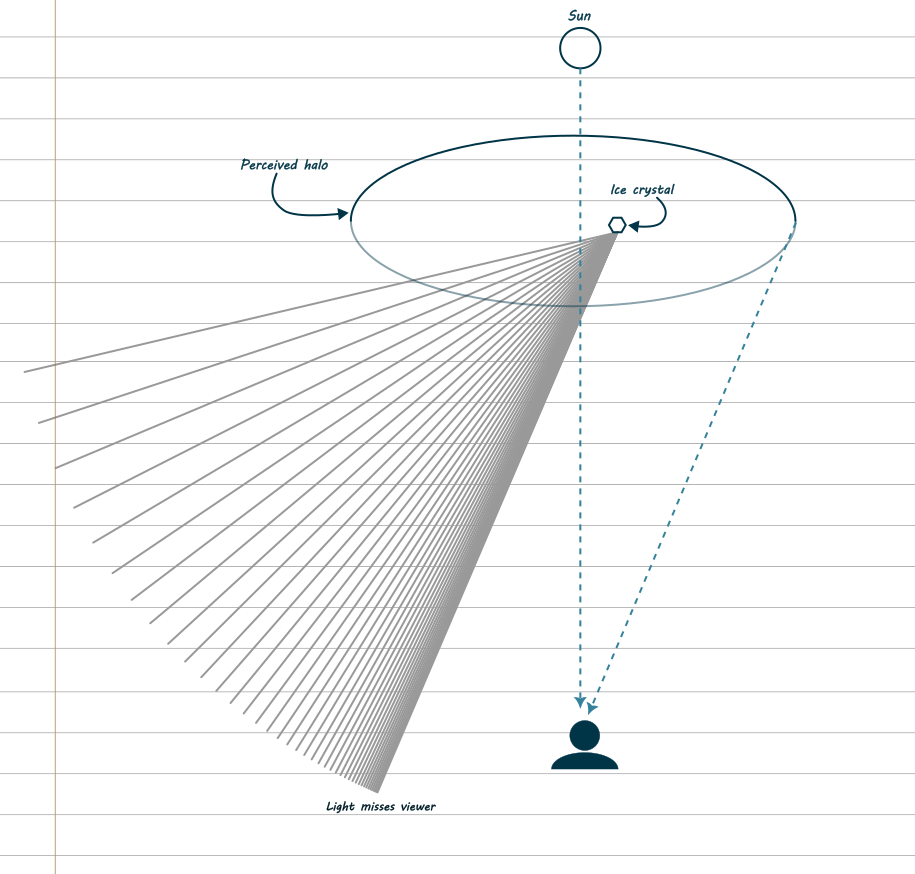
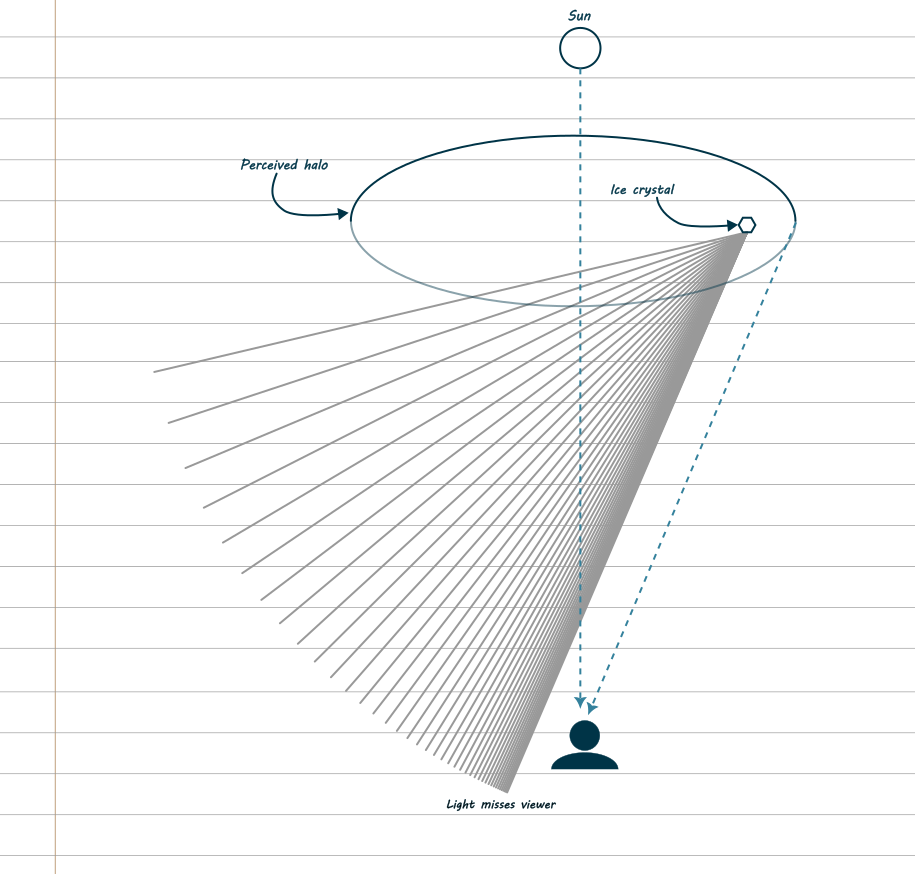
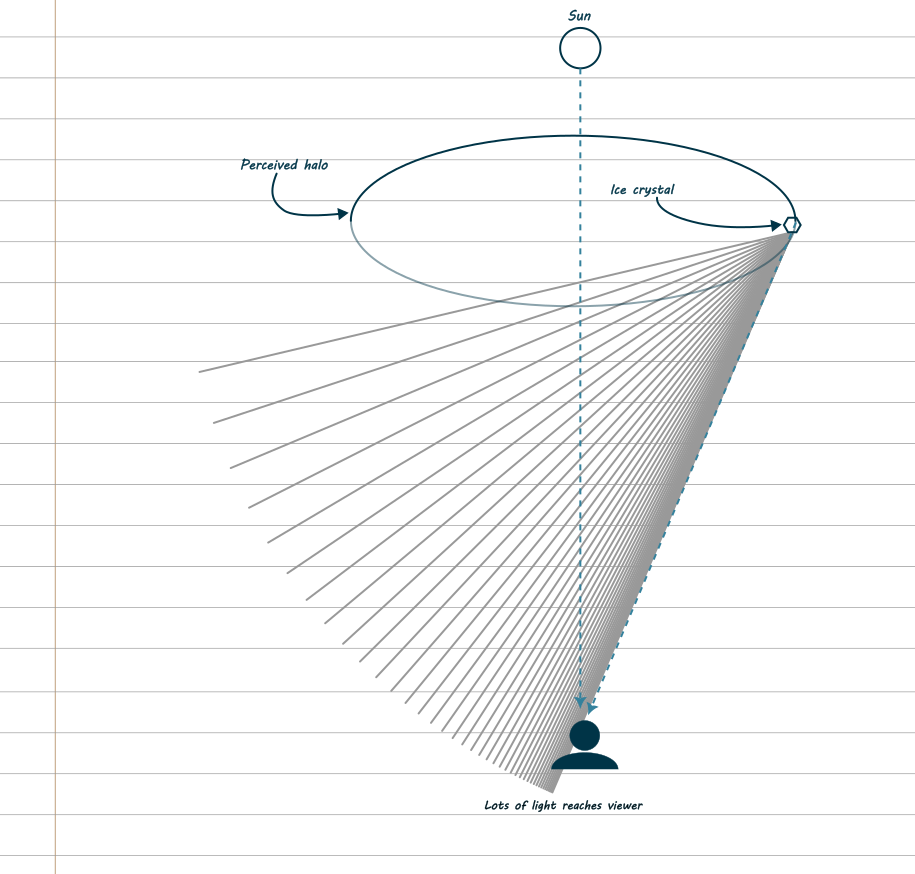
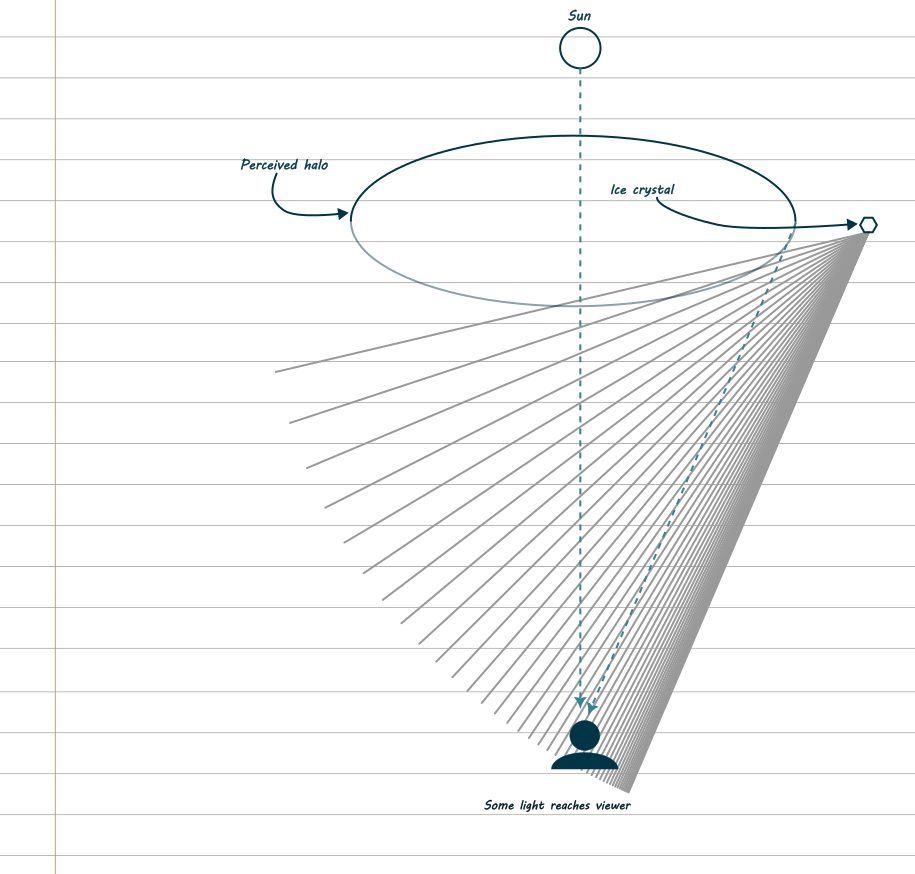
So this is why the sun dogs have quite a sharp edge on the side close to the sun, but are much more blurry on the other side. Nothing can be less than 22° so the sun side is sharp, but angles bigger than 22° are still possible. There are still some bits of light being deflected above 22°, but not as much as at 22°.
Where does the whole halo come from?
Up to now, all my pictures have drawn that the ice crystals floating sort of flat. That's not always the case, though! They can be floating in the air at all different angles.
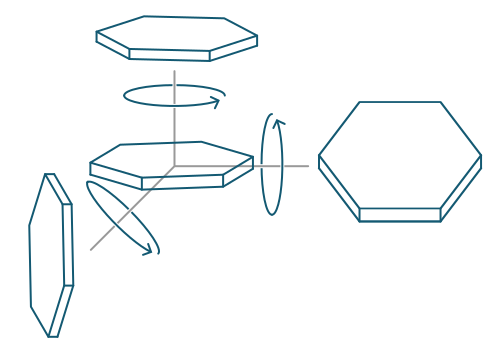
You get a whole ring around the sun because all these different crystals at different angles manage to bend light so that it comes at you. Some bend it down, so you can see the top of the ring, or sort of diagonally so you see the sides of it.
The sun dogs are the brightest part though! That's because it's more likely that the crystals are lying flat, so you get more light refracted when you look to either side of the sun, compared to above or below it.
Why is the inside edge red?
Remember when I said ages ago that the value of n changes depending on the colour of the light?
White light is made of lots of different colours. Lets plot the histogram again, but with red light, blue light and something in between all together.
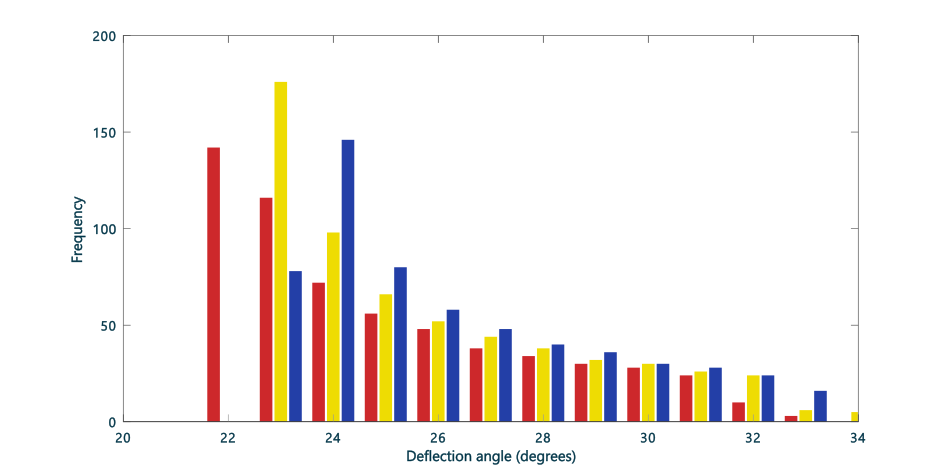
You can see that there are points where there's only red, and points where blue is way more common than red or yellow. How does that make a rainbow though?
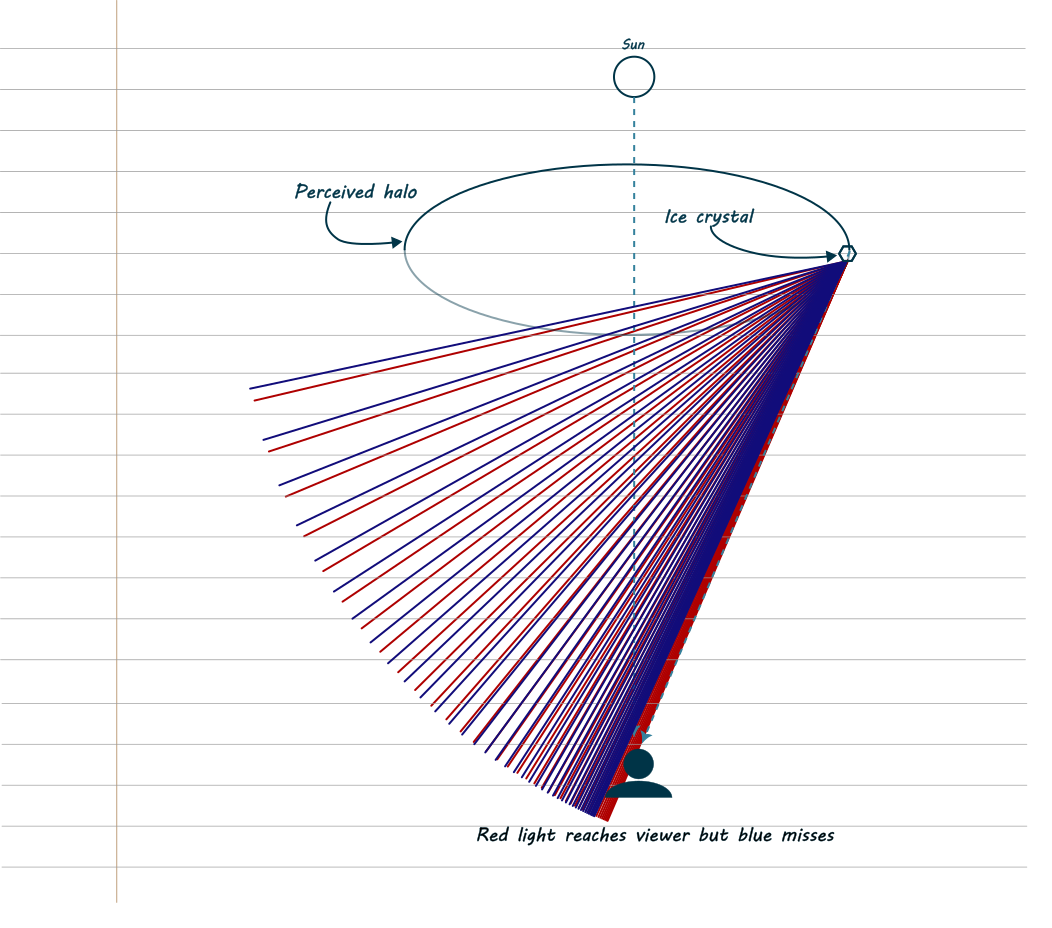
Right at the edge, there's no blue or yellow or any colour light except red that reaches you. Further out, though, there will be less red and more of the other colours. Look at the picture again - the red inside edge is really clear but the blue outside isn't very blue.
More reading