Fixing my car - August 2026
This is my car:
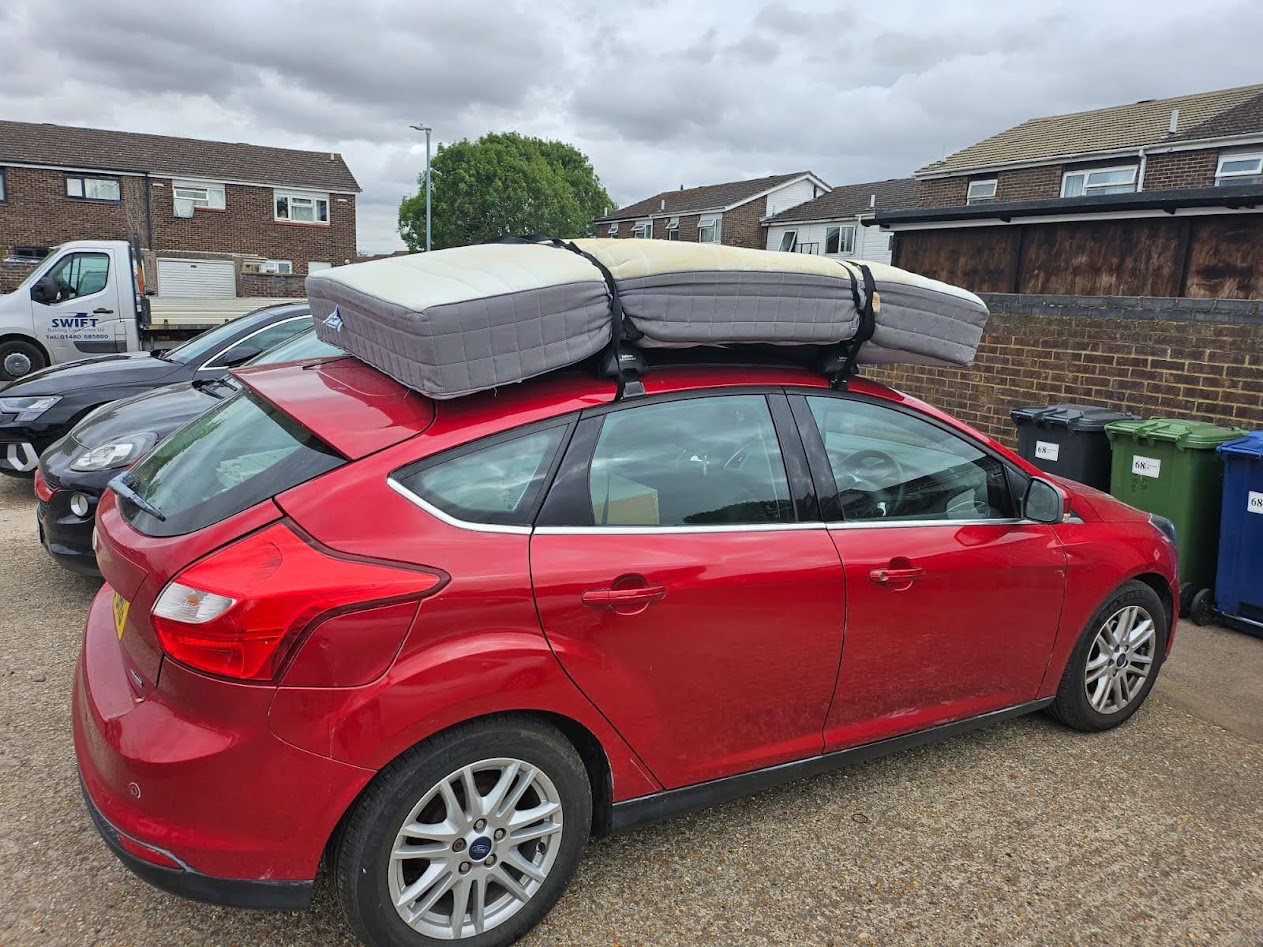
It's a Ford Focus MK3 Ecoboost 1L 125ps (6 speed). It's on about 87k miles and it's 14 years old. It has stubbornly refused all efforts to give it a name in the five years I've had it. I really love it.
Aside: it feels like a spaceship. My previous car was a MK1 Focus, a car whose design pre-dates USB 2.0. it was also a fairly low spec model. I replaced it with this, which is a 2011 design. The one I happened to pick was a top of the line spec. You can tell the titanium is aimed at old people because it has a pocket in the head liner to store your glasses in. It felt like a spaceship compared to my last car and frankly it still does. It may not be the most reliable but I love it.
About two months ago I got the check engine light on my dash. Ugh. Fortunately, working for an engineering company means there WILL be car nuts there. So I asked around for who would have an OBD reader (I have to go carefully every time I say that because I want to called it an odb, which is a file for specifying PCB designs).
Gilson is my hero <3 <3 <3
The problem
The OBD reader tells me that the problem is error code p0420, which says the catalytic converter is not working as well as it should.
This is roughly my understanding of car:
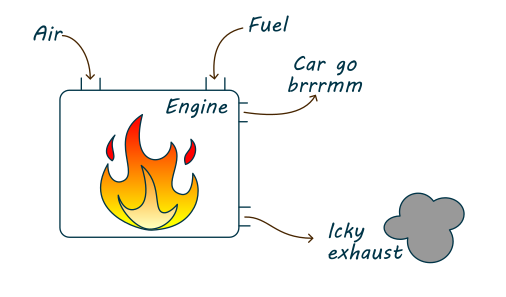
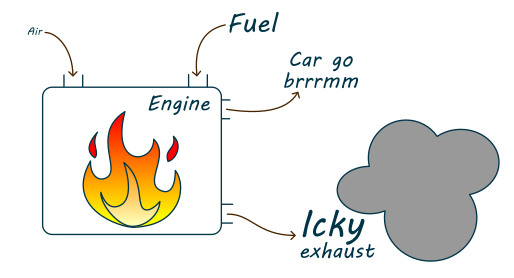
You put air and fuel into the engine bit and it sets them on fire. This makes the car go forwards and also makes exhaust spit out the back and give people asthma.
To try and cut down on the asthma thing (and because they were told to. Lets be honest, they wouldn't have changed anything if they didn't have to.), lawmakers decided to introduce 'emissions standards'. This specifies how much ick is allowed to be in your icky exhaust.
Unfortunately, the ick is an intrinsic part of the petrol and diesel we burn, so we can't just remove it from the source. Instead, it gets removed after the fuel gets set on fire.
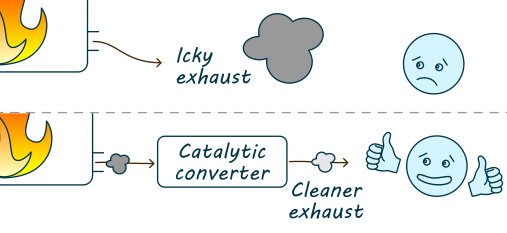
The catalytic converter uses catalysts to convert the harmful things—oxides of sulphur, nitrogen and carbonSOx, NOx and COx, aka socks, nocks and ... a third one.—into less nasty things.
The car has two oxygen sensors. One is before the catalytic converter and one is after. These calculate what proportion of the air is oxygen. The car must know that a certain percentage of the air is going to be ick, and so the proportion of oxygen in the air must have gone up by at least a certain amount for the catalytic converter to be working.
Fixing the problem
Step 1: ignore the problem and hope it goes away
Spoiler: it didn't.
First of all I just tried clearing the error code and hoping it was a blip. The first time I did this it took a while (like, 3 weeks?) to come back. But then I cleared it a few more times and it came back quicker. So that solution wasn't going to work.
Step 2: assume it's just too much ick
The sensors measure the amount of oxygen in the exhaust gases, right after they come out of the burny bit. Thus, the sensors have to be in the exhaust gases, right after they come out of the burny bit. Right where it's really hot. And full of all the aforementioned ick. So I just hoped the sensors had got a bit too clogged up and weren't working as well as they should. This is not an unreasonable assumption, by the way.
Attempt one to fix this was to buy a bottle of redex cleaner from lidl. You pour this into the fuel tank and then drive around at high revs and it, in theory, scrubs up the sensors.
Result: The warning light came back on.
Attempt two was to buy some contact cleaner and clean the sensors. Gilson (<3 <3 <3) lent me the tools for getting the sensors off. They are a complete pig, by the way. Not so much the sensors themselves, but unclipping the connectors.
(There will be more information on this later, if you're actually interested the p0420 error code on ford focuses and not just reading this to laugh at me. But right now, no spoilers!)
I cleared the error code once I'd done the cleaning with contact cleaner. At this point the CTO found out what I was up to and got interested. He offered me a can of really hardcore oxygen sensor cleaner.
Result: I got distracted before the warning light had a chance to come back on.
Attempt three, and I have a can of oxicat from the CTO.
I'm getting really good at taking the sensors off now! I took them off and gave them a good swill around in the cleaner. This was a liquid, rather than a spray. I wasn't really sure what I was doing at this point, I'll be honest. I swilled the sensors around and nothing visibly came out really, but I didn't want to leave them out of the car for ages? So I left the liquid in and put them back in the car.
Result: hahahahahahhahahahahahahahahahahahahaha
The next day I was driving to work. I got maybe two miles up the road and suddenly the car kinda lurched and slowed, just for a moment. Then it was fine again. That was terrifying. Maybe half a mile later I stopped at a roundabout. When I tried to pull off again I stalled. And it was not like 'DwarfPotato can't drive' stalling. I felt it start to go, gave it more fuel, ended up almost foot to floor, still nothing. I restarted the engine and it did start, and drove off, but the entire rest of the journey it was just utterly lacking in vroom. Zero beans.
I borrowed the OBD reader at lunch and asked the engine what it thought.
New terms time! The oxygen sensors are also known as lambda sensors. The whole time I've been having this problem, it's been telling me it knows the cat isn't working because lambda is too low.
Lambda is a measure of the air-to-fuel ratio. It helps the car to decide if it is putting in the right balance of air and fuel to get the best performance (where performance includes efficiency as well as vrooms).
If the engine is getting too much air, it is running lean. This is good because it means you get complete combustion: all of the fuel put in got burned. However, if it's too lean, it's kinda a waste of engine. You won't get all the power you could do.
If the engine not getting enough air (i.e., it's getting too much fuel), it's running rich. Rich is good when you want to get as much vroom as possible out of your car. It does mean that you don't get complete combustion, though. That means your exhaust could contain carbon monoxide (bad). If any unburnt fuel made it from the engine into the cat, the cat is actually hot enough to set the fuel on fire there instead. That's what happens when a car backfires.
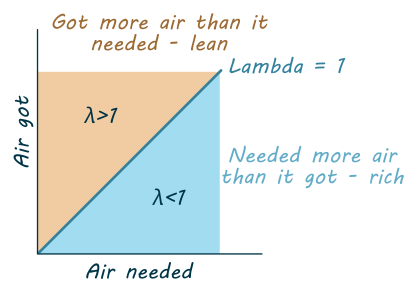
More exactly, lambda is the amount of air the engine got, divided by the amount of air it needed. So if lambda is 1, it got the same amount as it needed. This is ideal!
If lambda is less than 1, it didn't get as much air as it needed. It is running rich.
If lambda is more than 1, it got more air than it needed. It is running lean.
When I read the lambda value that day, after the car had crapped out twice and then limped to work, it was 0.595.
The oxygen sensors detect the amount of oxygen in the exhaust gases and so tell the engine to put in more or less fuel. Those sensors need to be warm so they have heaters in, but they still take a little while to get up to temperature. Before then, the car will just make a best guess on how much air to put in.
Once the sensors reported they were warm, the engine started listening to them. The sensors were still full of the cleaning liquid though, so not reading the oxygen levels.
The sensor was full of oxicat so its reading said there's like. NO oxygen at all. You're running suuuuper rich right now! (because lambda was substantially less than 1).
So the engine goes 'oh crap, too rich? Less fuel! less fuel!', and cuts the amount of fuel going to the engine. This is a sensible reaction under normal circumstances.
Except, in this situation, the engine wasn't actually running rich. The sensor just said it was rich, when in fact it was fine. So all that happened was that suddenly the car wasn't getting any fuel at all, and stalled.
Oops.
The next day I read it again, and lambda was 0.767. Creeping up! The day after it was 1.08. Is it fixed???
A few days later, the engine light came back on again. Nope, not fixed.
Step 3: Actually spend money on the problem
I asked the internet how much a sensor would cost. The answer was 'somewhere between £30 and £350' (don't buy direct from Ford, kids). To make sure I got the right sensors, I was very smart and took photos of the codes on the sensors when I was cleaning them back in step 2. Obviously I need to buy both sensors because I don't actually know which one has gone wrong. They're also the sorts of things that start to die around this sort of age/mileage so it's worth replacing both while you're at it. I bought some online, sadly not as cheap as if I'd got the ones the website thought fitted my car but didn't actually, but I opted to get the right ones.
Then I replaced them! Very proud. A friend joked that we should film it and put it on youtube so you know what, here you go:
I only replaced them yesterday and haven't driven far since. The error takes a while to reappear because it takes an average, I guess? So I don't know if it's actually fixed. If it isn't, it's £240 for a new cat, and I'll be back with an update...