Using AI to come up with new enzymes
This article, from phys.org, begins: "As the use of AI spreads through every industry and becomes more of a part of our lives every day, researchers are also looking into ways it can be used to solve some of the world's biggest problems." This definitely feels like they're drawing on the rapid metastasising of generative AI: let's dive in and see if someone has actually found a use for it, or if this is just another case of reflected glory.
A chemistry lesson
The scientists wanted to find a new way of digesting plastics so they can be recycled [1]. Time for a chemistry lesson! Sorry, there's going to be a lot of terminology in here but I'll try to explain things.
Plastic is made up of chains of hydrocarbons; that is, things made of hydrogen and carbon.
An atom is a molecule made of just a single blob.
A molecule is a thing made of multiple atoms. The atoms can be all the same, or a mix of different things.
An element is something made of just one type of atoms.
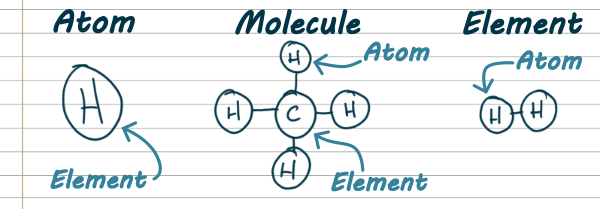
Chemists like shortening chemical names. All the elements have a symbol that's just a letter or two, so the scientists don't have to keep writing out the whole word. For all the 'basic' elements that we've known about for centuries, it's often just the first letter. So carbon is shortened to C, hydrogen is H. Then we found more things beginning with C (calcium and cadmium and cobalt, so we gave them two letters. Ca, Cd, Co.)
Hydrogen and carbon are atoms. Hydrogen is a gas and floats around in the air as a molecule made of two hydrogen atoms bonded together. (Whenever I talk about something being a solid, liquid or gas, I'm talking about at room temperature and pressure—so about 20 °C, at sea level.) A hydrogen molecule would therefore be written as H2. The little subscript 2 says there's two of the symbol before the 2 in the molecule. H2 is a 'chemical formula'.
Carbon is a solid and makes a whole bunch of really complicated different structures: for instance, graphite is made of pure carbon arranged in sheets, while diamond is a lattice of carbon atoms.
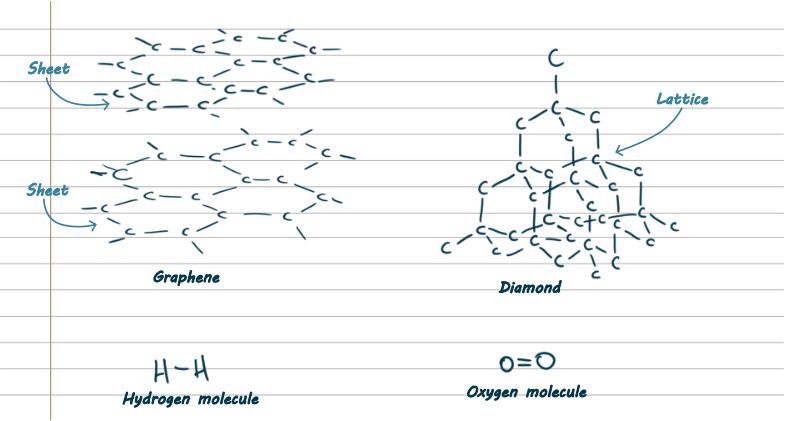
Methane is the simplest hydrocarbon and is made of four hydrogens and a carbon. This overall molecule is pretty small and light and so methaneOne carbon with four hydrogens is a gas. The chemical formulaShorthand writing down the elements and how many of them. for methane would be CH4.
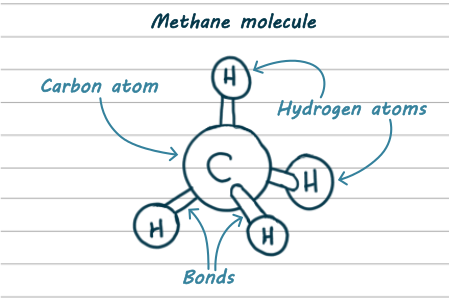
Carbon has four 'slots' for bonds. Hydrogen has one. So each hydrogen makes a single bond with one of the carbon slots, until all the slots are full.
Atoms don't like having their slots unfilled, so they'll react with (form bonds with) pretty much anything that comes near.
Ethane is the next simplest after methaneOne carbon with four hydrogens. It has two carbonsAn element with four spaces for bonds. and some hydrogensAn element with space for one bond.. The carbons have a bond between them, using up one slot each. That means each one has three slots left over, and they get filled with hydrogens. It has the formulaShorthand writing down the elements and how many of them. C2H6.
Propane is next. It has three carbon atoms. The two on the ends have three hydrogensAn element with space for one bond., and the one in the middle has two (because two of its slots are taken up with carbon atoms).
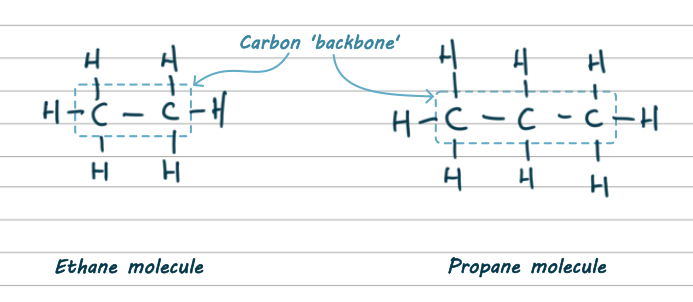
You can keep just making these chains longer and longer. The structure is the same: a 'backbone' of carbonAn element with four spaces for bonds. atoms linked together, and then hydrogensAn element with space for one bond. to fill up all the holes.
When you're just making things out of hydrogen and carbon, you can't have a structure other than basically that shape, because hydrogen can only have one bond. You can't put it in the middle of a chain because it can't in the middle of something if it can only have one bond!
The chains all have different names. One carbon atom is methane, two is ethane, three is propane, four is butane. All of those are gases. The names get a bit less imaginative after that: pentane, hexane, heptane and octane have five, size, seven and eight carbons in a chain. You might recognise some of those names too. You can keep making the chains longer and longer but after a while the names get less well-known.
While butane (four carbons) is a gas, pentane (five carbons) is a liquid at room temperature. As the molecules get bigger, they get heavier and so they float away less easily. (That's the simple explanation).
Now, all of those have the same basic structure of a long chain of carbons. We can play around with that and make different things.
Double bonds
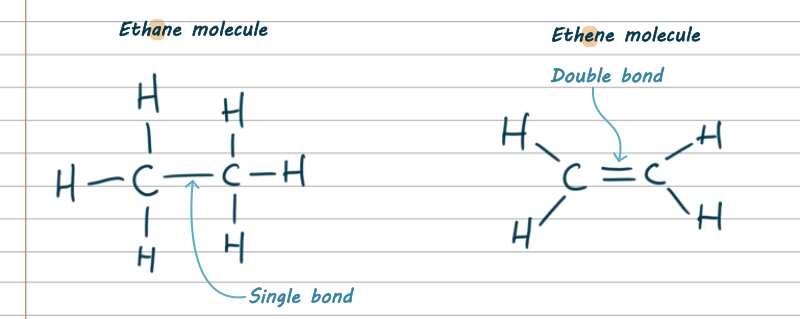
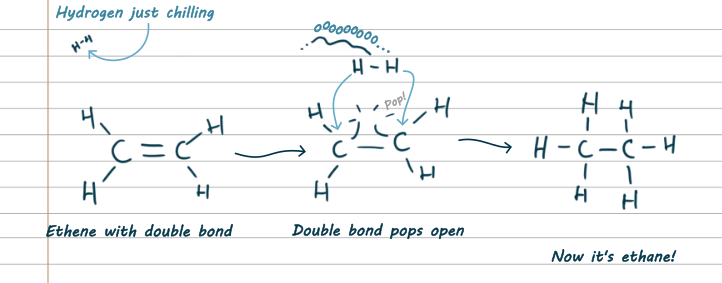
Ethene (also known as ethylene) is similar to ethaneTwo carbons, six hydrogens, all single bonds. The carbon atoms have all these empty slots after making that bond together, so sometimes they can make a double bond, using up two slots each. Then, they only have room for two hydrogensAn element with space for one bond. each. Those double bonds are a bit strained and have a tendency to pop open, making etheneTwo carbons, four hydrogens, a double bond between the carbons more reactive than ethane. You can have double bonds between any pair of carbonAn element with four spaces for bonds. atoms in the chain.
Branched chains
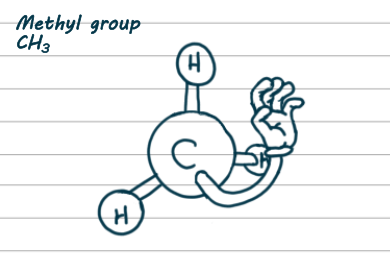
Methylbutane is five carbonAn element with four spaces for bonds. atoms, like pentane. Instead of having all the carbons in a row, though, one of them has wandered round the side. That's where the name comes from: it's a butane (four carbons long) with a methyl group stuck on the side. With longer chains, there's even more different options for sticking different its out the side!
Oh yeah, groups. Chemists call things 'groups' or 'functional groups' sometimes. They're like building blocks. They're a small clump of elements and, enerally have one bond left to make. With that one bond you can stick them to other things. So a methyl group is a methaneOne carbon with four hydrogens missing a hydrogenAn element with space for one bond.. Without that hydrogen, the carbon has a spare slot, which it uses to grab onto things.
Other elements
So far we've just made things out of carbon and hydrogen atoms. We can add different elements in the mix too, and get even more different effects. The two most common to get added in are oxygen and nitrogen.
Hydrogen has one slot for bonds. Carbon has four. oxygen and nitrogen neatly fit in the middle: oxygen has two and nitrogen has three.
What different things can we make with these guys added? Probably the most famous is ethanol. I expect you've heard of that one. It's got two carbons so it's got the 'eth' start. Instead of one of the hydrogens it has an 'OH' groupBuilding blocks of a few atoms clumped together, with a spare bond., also called an alcohol group. So, for most people "alcohol" means the thing in beer and wine and spirits that makes you tiddly. For chemists, "alcohol" is anything with this 'OH' group, and the thing in beer and wine and spirits that makes you tiddly is specifically ethanol.
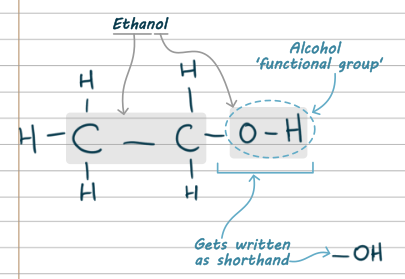
I said 'OH' is a functional groupBuilding blocks of a few atoms clumped together, with a spare bond.. Look how the oxygen has made two bonds – one to carbonAn element with four spaces for bonds., one to hydrogenAn element with space for one bond.. I said ages ago that sometimes carbons make double bonds with each other. Carbon and oxygen can make a double bond too. So a carboxylic acid group actually has both of those: a double bond between a carbon and an oxygen, and a little chain of a carbon, then an oxygen, then a hydrogen, also with single bonds.
(Remember, a carboxylic acid is a functional groupBuilding blocks of a few atoms clumped together, with a spare bond., so it has a spare bond for grabbing onto other things.)
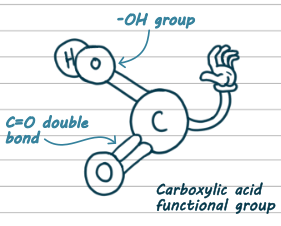
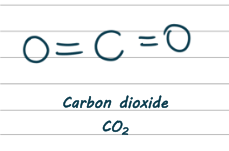
Fun fact! You could even have a carbonAn element with four spaces for bonds., with four bonds, double bonded to two oxygens! Given you can shorten carbon to C, and oxygen to O, and if you have two Os you could shorten it to O2, and stick it all together and you've got… CO2, carbon dioxide. So there you go.
Nitrogen has three slots, so you can connect one or two (or three; a special case) of them to carbonAn element with four spaces for bonds., and any spares to hydrogenAn element with space for one bond.. Hydrogen is great—any time there's a spare slot, just whack a hydrogen in there.
Oxygen and nitrogen are special
Oxygen and nitrogen are actually really special guys. They're about the same size/shape as carbon and so in theory they have four slots for bonds. But actually, one (nitrogen) or two (oxygen) of those slots are filled up with electrons. Oxygen REALLY likes negative things.
Electrons are negatively charged, and negative things repel other negative things. When you rub a balloon on your hair, you're wiping electrons off the balloon and onto your hair. Your individual hairs then repel each other because they're all negative. They stick to the balloon though, because that's positively charged (it lost the negative electrons, so it got made more positive), and positive and negative things are attracted to each other.
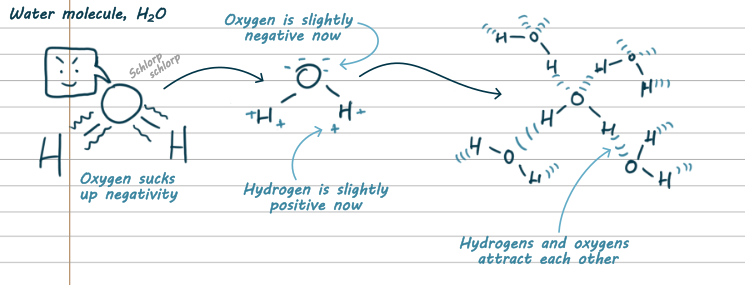
Because oxygen really likes negative things, it kind of sucks the negativeness out of a hydrogenAn element with space for one bond. and leaves it slightly positive. Water is H2O, meaning it's two hydrogens and an oxygen.
If a hydrogen is slightly positive, and an oxygen has sucked all these electrons to itself and made itself slightly negative, and positive and negative things attract each other, you get these slight forces between oxygens and hydrogens in different water atoms. This makes them stick together a bit more than if there weren't these forces. This is why water is a liquid at room temperature, even though it's a really small light molecule and I said those are generally gases. In fact, one water and one methaneOne carbon with four hydrogens weigh about the same! The waters all grab each other, though, and the methanes don't, so the methanes can float away much more easily than the waters. So it's a gas, not a liquid.
Oxygen often makes these double bonds, and nitrogen makes triple bonds. I said that double bonds between carbonsAn element with four spaces for bonds. are quite prone to popping open, and that's true for oxygen and nitrogen too. And if a bond pops open, suddenly two of those atoms have slots that aren't filled. And nothing likes unfilled slots, so they try and grab onto something nearby.
Monomers and polymers
Mono- means one. Poly- means many. Clearly, then, this is a monomer and this is a polymer.
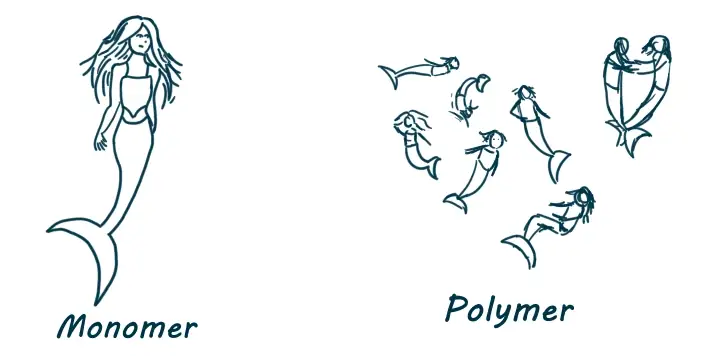
In reality, a polymer is a big big molecule made up of the same thing, repeating over and over. The 'thing' is the monomer.
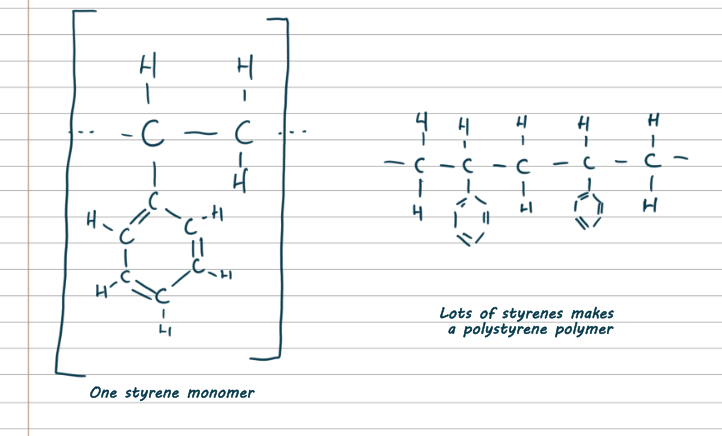
Lots of things are polymers: polystyrene, polyethylene. PVC is polyvinyl chloride. PVA is polyvinyl acetate.
This is a styrene [8]:
Polymers don't have to be man-made, though. Carbohydrates are long chains of sugars tied together. In that case, then, the monomerOne copy of a repeating segment in a polymer. is a sugar (saccharide, or monosaccharide), so the polymer is a polysaccharide. Lots of scary sounding chemical names for things that are actually just jam on toast. In fact, the butter on your toast is technically a carboxylic acid: a long chain of carbonsAn element with four spaces for bonds. with a carboxylic acid functional groupBuilding blocks of a few atoms clumped together, with a spare bond.. If it has no double bonds between the carbons, it is a saturated fat: it's got as much hydrogenAn element with space for one bond. as it can take. If it has one double bond in the chain, it is a monounsaturated fat. If it has more than one, it is a polyunsaturated fat. If you wanted to make it more saturated, you'd add hydrogen in a process called hydrogenation. Anyway.
What is polyurethane?
Polyurethane [5] is a polymer. Well, a type of polymer. Polystyrene is called that because it's lots of styrenes stuck together. In the past, scientists played pretty fast and loose with the names they made up for things. In this case, the "urethane" part of the name doesn't refer to the monomerOne copy of a repeating segment in a polymer., but to the type of bond between the monomers [6]. To make polyurethane, you mix together two different types of monomers called diisocyanates and polyols.
An isocyanate [7] is something with an N=C=O functional groupBuilding blocks of a few atoms clumped together, with a spare bond.. This group has to stick out because the O has no bonds left. The N has one bond left so it sticks to something else. The 'di' part means it has two of these, so a diisocyanate is a monomer that has two isocyanate functional groupsBuilding blocks of a few atoms clumped together, with a spare bond..
A polyol is something with more than one alcohol group. Remember that, in chemistry language, -ol means it has the -OH group on it, like ethanol (ethaneTwo carbons, six hydrogens, all single bonds + -ol). Poly is a generic term for anything with more than one -ol. Like with diisocyanates, you could have something with just two -ols and it would be a diol.
When you put an isocyanate and an alcohol groupBuilding blocks of a few atoms clumped together, with a spare bond. together, they react and make a bond. That means if you have something with two isocyanates, and something with two (or more) alcohol groups, they keep making more and more bonds and make a big chain of alternating monomers.
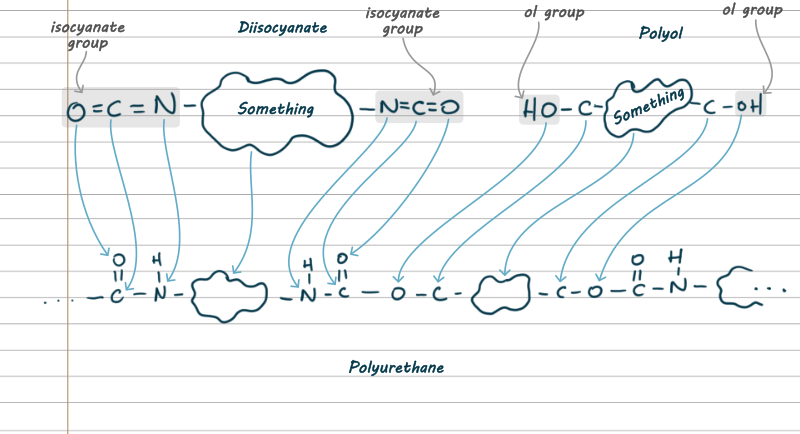
What goes in between the two isocyanate groupsBuilding blocks of a few atoms clumped together, with a spare bond. in one monomerOne copy of a repeating segment in a polymer., or between the two alcohol groups in the other monomer, can change. That's why polyurethane is a group of chemicals, not just one like polystyrene.
The scientists' plan
Right now, it's really hard to break down polyurethane. A lot of the things made from it are thermosetting: that means you heat them up and shape them, and then they cool down and set. The setting process results in lots of new bonds being made, so if you heated it back up it wouldn't go back to being shapeable. So while you can heat up some plastics and bend them into something else, you can't do that with most polyurethane.
This is also a problem because polyurethane is used EVERYWHERE. Annual global consumption was 22 million tons in 2024, and considering a lot of it goes into lightweight and bulky things like foam, that's an awful lot of plastic we can't do anything with.
What we need is something to break the urethane links down so we can get the polyurethane back to its monomersOne copy of a repeating segment in a polymer.. Then we can stick them back together and make new products from them. We have some methods of getting some of the bits back already, but often we can only get out the polyols and have to bin a toxic goop that contains all the diisocyanates. Breaking down that goop is really hard and uses lots of energy so it's better to just burn it and start again.
Breaking things!
Fortunately, nature and biology has lots of experience breaking things apart. We can't absorb or store big long carbohydrate molecules so our digestive system breaks them down into much smaller sugars. These are small enough to be absorbed. Your body then sticks them back together in a different form that it can store. Then when you go for a walk and need that sugar, your body breaks apart the stored form back into sugar and sends it to your muscles to use. Breaking a big long piece of starch into sugar is a chemical reaction: the bonds between the sugar monomers need to be broken. To make sure the right bonds break, and without using loads of energy, we have enzymes to help the chemical reaction happen.
Enzymes and proteins
An enzyme is a protein. A protein is a long chain of amino acids.
Proteins aren't usually considered to be polymers because they aren't made of the same thing over and over. Instead, there are 20/21/22Depending on exactly how you count them. different amino acids that act like an alphabet. Combining them in different orders makes different proteins.
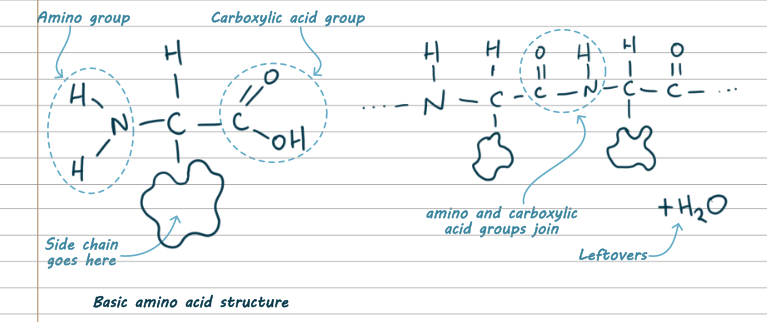
All amino acids have the same starting point, and then different bits ("side chains") are added on to get all the different types. They form a bond between the carboxylic acid functional groupBuilding blocks of a few atoms clumped together, with a spare bond. (-COOH) and the amino functional group (-NH2) of another. Because all of the amino acids have both of these bits as part of their starting point, you can put the amino acids together in any order you like.
Once you've made a long chain, the different side chainsThe extra bit you add to a standard amino acid to make it different interact differently and cause the long chain to scrunch up and tangle (like wired headphones in your pocket). If you made two long chains of amino acids with the same 'letters' in the same order, they would scrunch up exactly the same. Once they're scrunched up, they're a 3D shape (like the ball your headphones made).
An enzyme is a protein. Once it has scrunched up, part of the surface will neatly fit a certain molecule (or bit of a molecule). The special part of the surface is called the 'active site'. The molecule and the enzyme stick together, the chemical reaction happens, and then they all separate and go on their merry way.
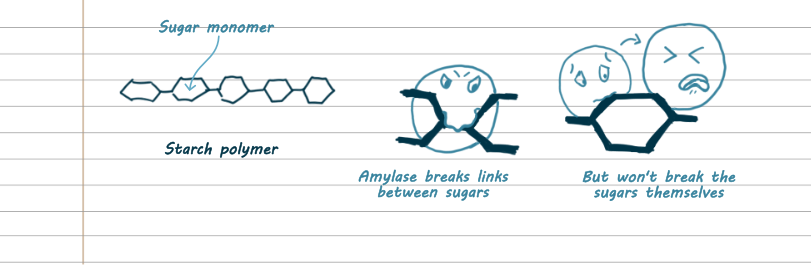
Here's a long chain of starch – a carbohydrate. An enzyme called amylase comes along and can stick to the bit where two sugars join together. It can't stick to other parts of the carbohydrate chain because it isn't the right shape. It isn't too picky about which sugars are either side of the bond because they aren't the important bit.
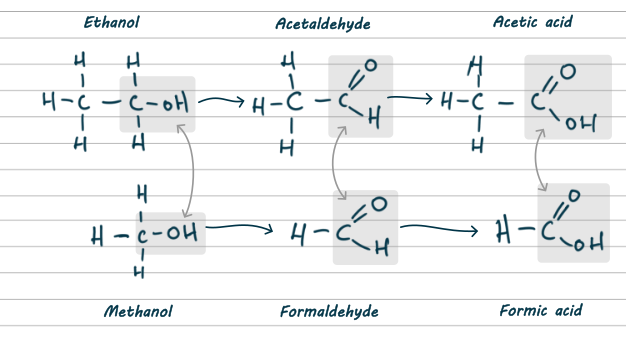
Enzymes are why methanol poisoning is bad. Methanol and ethanol are similar sized molecules so they can stick to the same cells and things in your body. Unfortunately, the chemicals they make are quite different and so the end result of one of them is harmless and the other is deadly.
Ethanol is turned into acetaldehyde and then into acetic acid. Acetic acid is the scientific name for vinegar, basically.
Methanol is turned into formaldehyde and then into formic acid. Formic acid is the venom that ants produce. So now your liver is full of ant bites, and then you die.
Formic acid stops your cells from being able to use oxygen by interacting with a different enzyme. The formic acid sort of fits in the active site, but not properly. The reaction the enzyme is supposed to do can't happen to the formic acid because it's not the right molecule so they get stuck together and can't break apart again. The chemical the enzyme is supposed to break down also can't to the active site because the formic acid is in the way, so the enzyme is useless. As the reaction is for giving your cells oxygen to use, blocking the enzyme makes your cells suffocate. Acetic acid doesn't block the enzyme in the same way and so doesn't poison you.
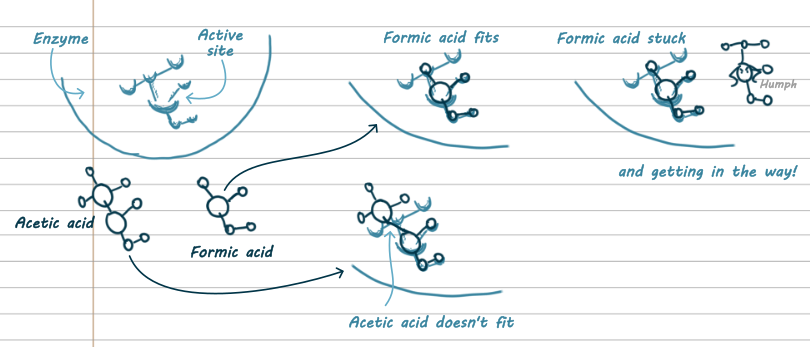
Obviously the amount of formic acid you get from an ant bite is so small it doesn't cause problems, and also because it's in your skin and not in your digestive system. So it might kill a few cells where you got bitten, but your body deals with that during the healing process.
In researching this, I discovered that the English word ant comes from ante (middle english), from ǣmette (old english), from west Germanic ǣmaitjōn. The original meaning of this word was 'the biter'. So ants are literally named for being bitey little buggers, at least in Germanic languages.
Methodology
So the scientists have decided they want an enzyme to break down the urethane link specifically. They looked in lots of other papers published on similar topics and drew up a list of 14 enzymes that broke similar sorts of chemical bonds, or the same bond but in a different situation. The plan is to take one of these, adapt it slightly and make it really good at what they need to do. First, they need to decide which one of them they're going to modify.
They picked one type of polyurethane for testing them. In the wild, this polyurethane comes in a mix of two different shapes (called 2,4 and 2,6 [chemistry name]2,4-TDA-DEG stands for bis[2-(2-hydroxyethoxy)ethyl] (4-methyl-1,3-phenylene) dicarbamate and the 2,6 is the same with one number changed, so that's why I said [chemistry name]. They'd be said out loud 'two four' and 'two six'). They put one shape in one pot and the other shape in another pot.
Then, they put each enzyme in the pots, one at a time, to see how good they were at breaking them down. They had mixed results.
One of the enzymes (lets call him Adam) worked much better on the 2,4 shape than the 2,6 shape, but it did get there eventually for both, so that was an okay result.
Another enzyme (Greg) sort of worked on the 2,4 shape but got stuck at a halfway stage, and almost didn’t work on the 2,6 at all. That one wasn't very good.
A third enzyme (Steve) was really good at the 2,6 shape but pretty slow at 2,4.
The rest of the enzymes didn't work at all. Polyurethanes are hard to break down.
In the real world, there's a lot more 2,4 than 2,6 in a mixture so the scientists decided Adam was their best shot.
Here's where there's some AI!
Various scientific institutes have made huge databases of all the different ways you can fold proteins, and enzymes are just folded proteins. The scientists used these databases to find other proteins similar to Enzyme Adam, to see what little modifications they can make and what effect they would have.
The searching of these databases does actually use some AI! These databases are HUGE and the things they're comparing are really complicated. Using normal search methods, it might take one tool a month to compare one protein to all the other ones in its database. Someone has made a program called FoldSeek [2], which searches much faster. FoldSeek uses a bit of AI for its searching.
At this point the biology is going WAY over my head… As far as I can tell, it takes the structure and describes it using their own terminology. The terminology is based not on the exact building blocks that make up the protein, because they're huge. Instead, it is based on how the protein will act—how it will fold and curl up, what bits will be close to where, what angle different bits will be to each other. This is where the AI comes in—they trained it on 100 000 proteins so that it could learn how different things interact, so when you feed it a new one it can come up with a good guess of how it will act.
They used a neural net called VQ-VAE [3] to learn how these proteins fold. This neural net divides something big into chunks and makes a summary of just the important parts of it, reducing the amount of data you've got to deal with. This is another thing like a CNN or a transformer—so much of AI is trying to compress huge, noisy datasets into something usable.
They trained this net on lots of proteins so that it could work out what the important features are, and what can be ignored. The output of the VQ-VAE net can then be fed into their search algorithm, and they've got a lot less that they need to search through.
An analogy would be that it's much easier to see if two four-letter keysmashes contain the same letters, than comparing two fifteen-letter keysmashes. (are hugf and poge the same? No. Simple. What about hviduhgsavurwh and wgsuihhvhruvda? I'll wait.) And it's going to be much MUCH quicker to compare two million four-letter keysmashes than two million fifteen-letter keysmashes!
VQ-VAE was developed by some researchers at Google Deepmind, and to demonstrate it they had it generate pictures and videos, so it is usable for generative AI. However, so are transformers, but not all transformers are genAI.
So, is FoldSeek generative AI?
- It isn't a foundational model, nor is it built on one. It is build on VQ-VAE, which is a design for a neural net, not a model itself.
- The training data was just proteins; it wasn't huge amounts of text that they're trying to extract meaning from. Because it's specific, the model is much smaller and lighter.
- Unfortunately neither the FoldSeek nor the VQ-VAE papers discuss power requirements.
Conclusion: FoldSeek is not generative AI.
They used another sort of search called BLASTp too, but that one is almost the most basic sort of search. It pretty much just does pattern matching; that is, you have to know you want a string of amino acids that says A-B-C-D, so it searches through the database for anything that says 'A-B-C-D'. It has some ... flexibility (I hesitate to use the word intelligence here, for fear of misunderstanding). It can return things that are similar, as well as identical. It knows that A-B-C-D is 100% identical, that I-B-C-D is 95% the same (because I is just like Australian A, right? It kinda functions the same) but X-B-C-D is only 75% the same. X is nothing like A so only the B-C-D is a match.
BLASTp has other things in to help with finding similar things too, but it's closest to just pattern matching really. You have to know what you're looking for.
They also had a third method of searching for different protein structures, to do with clusters.
In this method [4], they started with a huge load of different options. They came up with a number for how similar each option was to all the other options and gave it a number.
Imagine you have five things and you want to map how similar they are to each other on a graph. If two things are very similar, the link between them gets a small number, eg. 1. If two things are very different they get a big number. I dunno, 50.
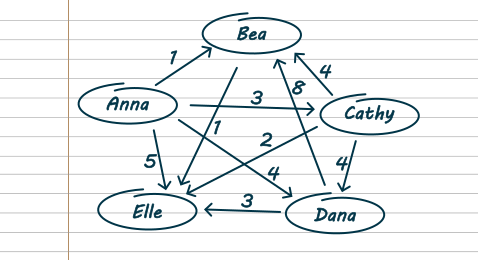
Now, connect them with a stick that's that many centimetres long: short sticks for similar things, long sticks for dissimilar things. As you're connecting things, you'll have to keep moving things around and rearranging so you can get a surprise long or short stick in.
When you've finished, hopefully it will lie flat. Then, you can see what things are close to other things. You might be surprised to find that some things have ended up quite close to each other even though they are from different groups.
This method is roughly what they did for the cluster method, but obviously a lot more mathematically… The result was a 2D graph that let them see where there were groups of things all together. They would then test a couple from the bigger groups and find out which ones had the best results.
Did the cluster method use any AI at all? Nope. No probability, just iterative maths.
They picked the best ten results from two database searches (FoldSeek and BLASTp), five from each, and tested them. They also took the twelve best-looking results from the clusters method, and tested them too.
From the database searches, one was a bit better than our enzyme Adam, three were ok. Two were completely useless. From the cluster search, almost all of them did nothing. There was a tiny bit of activity from two of them, but even they were awful.
These traditional methods all use different ways to guess how the chemical will behave, to help you try to find things that are close to your chemical. Proteins are made up of long strings of amino acids, and all of these search methods are based on you giving it the string of amino acids and it guesses how they'll work from that. They all tend to assume that if some sequences are similar, they'll work about the same. Unfortunately, that's not always the case: for instance, deck and dock are similar I guess? Both things around boats and water. Put an i instead and suddenly you're on a completely different topic! The same happens in proteins.
Deep learning about proteins
You could instead train an AI on the structures themselves, using some really intense biology to get a good representation of the structure. This is what the researchers here did, and they called their solution GRASE.
First, you make a sort of numerical representation of the shape of the protein (forwards four, up two, left three sort of thing).
One neural net took that information and worked out exactly what angle all the corners would be, and so they could overall work out exactly what shape it would be. That shape can be represented as a series of numbers.
Another neural net took the shape information and compared it to each amino acid individually, looking at the neighbouring amino acids for context, and works out roughly where each amino acid is going to be as a probability. This neural net used multi-headed attention, which is the same as what is used in the transformers used when scanning images for green citrus fruit.
The first neural net, giving the shape, lets you know if the enzyme is going to do what you need it to do. The second net is better for telling you if the enzyme is going to be stable, or if it's all going to fall apart if you try to make it.
They can then look at both of those results for each possible protein they come up with, and make a score that covers both. The calculating of this score isn't AI, it's just maths.
The results clustered together quite a bit, so they took from each group the one predicted to be most stable, manufactured and tested it. They tested 24 enzymes from their new method. Of them, eight were better than the original Enzyme Adam. The best one, which we're going to call Gary, was 32 times better than Adam at the 2,4 shape and 62 times better at the 2,6 shape polyurethane.
Conclusion
So, is GRASE generative AI?
- It isn't built on a foundational model like ChatGPT or DALL-E.
- It used just relevant training data, not the entire corpus of human knowledge, and they acquired it legally.
- The paper doesn't discuss how much power it uses, but the entire GRASE model is available to download in a 54MB zip file so I'm not sure how much power it can possibly use.
Verdict: Nope, they just used normal AI and machine learning to make something really good at dissolving polyurethane foam.
Breaking down plastics is a really useful thing for people to be studying. Chemical reactions are hard to make work well—often you have to heat things up to high temperatures, or use expensive or toxic chemicals to help the reactions happen faster. If we can use new techniques to find things that help us recycle plastic more easily, that's brilliant news for humans and the planet; ultimately, plastic is incredibly useful and its ubiquity isn't going away any time soon. (I love my memory foam pillow. That's polyurethane!)
This paper has demonstrated that we can get extraordinary results using AI, applied in the right way. An LLM trained on millions of books, including all the sci fi and fantasy and romance and political science textbooks ever written, is not going to be an efficient way of finding new chemicals or repurposing existing ones. In the same way, an AI trained on folding proteins isn't going to write the next great romantasy novel.
It is interesting to note that the AI, GRASE, didn't invent a new enzyme: it provided an efficient way of searching existing knowledge to identify links that may have previously been missed. This is what AIs are amazing at - spotting patterns in data.
ps: this paper includes the fantastic line, "This observation aligns with the broader body of research on enzyme promiscuity and moonlighting".
References
[1] Glycolysis-compatible urethanases for polyurethane recycling, Chen et al., 2025. Science, vol. 390, issue 6772, pp. 503-509.
[2] Fast and accurate protein structure search with Foldseek, van Kempen et al., 2024. Nature Biotechnology, vol. 42, pp. 243-246.
[3] Neural Discrete Representation Learning, van den Oord et al., 2017. 31st Conference on Neural Information Processing Systems (NIPS 2017)
[4] Landscape profiling of PET depolymerases using a natural sequence cluster framework, Seo et al., 2025. Science, vol. 387, issue 6729. Ref: adp5637.
[5] Polyurethane, wikipedia.org, accessed: 26/11/25
[6] Carbamate, wikipedia.org, accessed: 24/11/25
[7] Isocyanate, wikipedia.org, accessed: 26/11/25
[8] Polystyrene, wikipedia.org, accessed: 26/11/25
Also thanks go to my friend Emily for her help when the biology got too squishy for me.
Ok, but...
What criteria do I use to decide if something is generative AI?